Collaboration: Perspectives, Users and Teams
Three Runners and a Pool
Three cross-country runners wrote a training log for their school's sports teams. It recorded the distance and pace of each run. Then the swim coach asked her team to try it. Swimmers count lengths, and a pace per mile means nothing in a pool. The wrestlers could not use it: their training has no distance in it.The program fit the people who built it. None of the three swims, so none had a reason to think about lengths.
Perspectives
Suppose four people stand on the north side of a statue and describe it. They agree on every detail; none can describe the back. A perspective is where a person stands: what they do and what they never had to think about.Effective collaboration produces a program that reflects the talents and perspectives of everyone who designed it. A team standing on several sides describes more of the statue. That is how collaboration helps a team avoid bias, a program that fits one kind of person and fails another. Nobody wished swimmers any harm. The three had never stood on their side.
Users Are a Perspective Too
Users stand where the team may never stand. Consulting them means asking, watching and listening while the program is still being written. Thus the wrestlers were part of the design without writing a line. Information gathered from potential users can show what a program is for from several perspectives. The team can then build a program that fully incorporates those perspectives. The figure shows the log before and after the team watched its users.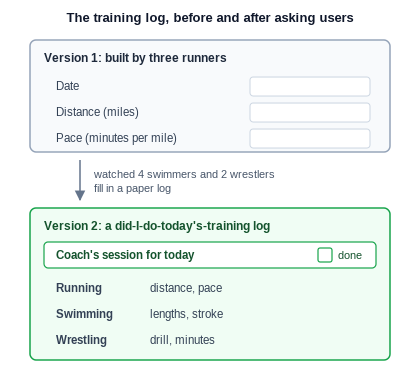
Tools and Pairs
Online tools support collaboration by letting a team share ideas and documents and give feedback on them. Priya's note in the margin is the feedback; the project only carried it.Pair programming is two people at one keyboard. One types. The other watches each line, questions it and thinks ahead. They swap often. Alone, Marco would not have seen the turn bug.