Computing Innovations and Their Effects
Computing Innovations
A computing innovation includes a program as an integral part of its function.A program is a collection of program statements that performs a specific task when run by a computer. A program is often referred to as software. It can be written in different programming languages like Python or Java.
That first sentence is doing more work than it looks. It does not say a computing innovation is a computer, or a gadget, or something recent. It says there is a program inside it doing something the thing could not do without it.
| Kind of computing innovation | What that means | Example |
|---|---|---|
| Physical | An object you could put on a table, whose function depends on a program running inside it | A self-driving car |
| Nonphysical computing software | Software you run, with no new physical object of its own | Picture editing software |
| Nonphysical computing concept | A way of doing something that exists only because programs make it possible | E-commerce |
Purpose
The purpose of computing innovations is to solve problems or to pursue interests through creative expression. An understanding of the purpose of a computing innovation provides developers with an improved ability to develop that computing innovation.Notice that two quite different things are named there. Solving a problem is one of them. Pursuing an interest through creative expression is the other, and something built purely because its maker enjoyed making it is a computing innovation with a purpose, not a computing innovation without one.
Changing How Tasks Are Done
People create computing innovations, and the way people complete tasks often changes to incorporate them. A driver with a map app rarely plans a route before leaving, because the app plans it on the way. A shopper pays by holding a phone near a card reader instead of counting out cash.Effects Are Not the Same Thing as Purpose
Not every effect of a computing innovation is anticipated in advance. Some effects are harmful.For example, the inventors of television, computers, mobile devices and social media did not set out to harm children. Critics argue that these innovations have contributed to harms anyway: shortened attention spans, less connection to nature, and bullying and hate groups that reach children online.
None of those was the purpose of any of these innovations.
Beneficial Effects
Many effects of innovations are beneficial. Advances in computing have generated and increased creativity in other fields, such as medicine, engineering, communications, and the arts.The creativity is in the other field. A program that lets someone try something they could not have attempted before has increased what that field can do, without anyone in it becoming a programmer.
Many of these benefits were never planned. Computing innovations have often had unintended beneficial effects by leading to advances in other fields. Graphics chips were built to draw video game scenes quickly. The same chips turned out to suit the arithmetic that machine learning needs. Much of the machine learning in medical and scientific research now runs on them.
Used In Ways the Creator Did Not Intend
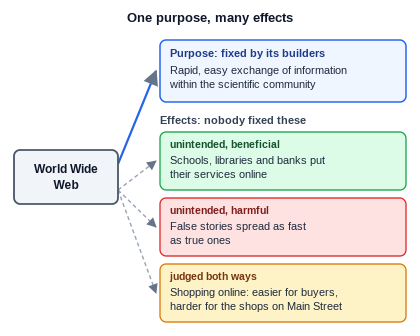
Computing innovations can be used in ways that their creators had not originally intended.The World Wide Web was originally intended only for rapid and easy exchange of information within the scientific community. Today schools, libraries, banks and shops run their services on it.
Targeted advertising is used to help businesses, but it can be misused at both individual and aggregate levels, compromising, for example, personal privacy.
Some of the ways computing innovations can be used may have a harmful impact on society, the economy or culture. Using social media to spread fake news is one: a false story can reach millions of readers as fast as a true one. Online shopping is judged both ways: easier for buyers, harder on the shops of a town's main street.
Machine learning and data mining have enabled innovation in medicine, business, and science, but information discovered in this way has also been used to discriminate against groups of individuals.
Responsible programmers try to consider the unintended ways their computing innovations can be used, and the beneficial and harmful effects of those new uses. It is not possible for a programmer to consider all the ways an innovation can be used. The Web's designers built a tool for sharing research and did not list shopping, streaming or social media among its uses.
Scale Is Its Own Effect
Rapid sharing of a program or running a program with a large number of users can result in significant impacts beyond the intended purpose or control of the programmer.This one surprises people, because the program has not changed. It does the same thing on the last machine to run it as it did on the first. What changed is how many machines there are, and the programmer who wrote it is standing next to none of them.