Privacy, PII and Safe Computing
Privacy and Security Are Not the Same Word
Privacy and security concerns arise in the development and use of computational systems and artifacts.Privacy relates to any rights you have to control your personal information and how it is used. A bank selling your information to marketers without your consent is a breach in privacy.
Security refers to how your personal information is protected. Cybercriminals breaking into the bank's servers and stealing your information is a breach in security.
| Privacy | Security | |
|---|---|---|
| The question it answers | Who may use your information, and for what | How well is your information protected |
| Who fails | The organization holding it | The protection around it |
| An example | A bank sells your information to marketers without your consent | Criminals break into the bank's servers and steal it |
| Notice | The bank meant to do it | The bank did not |
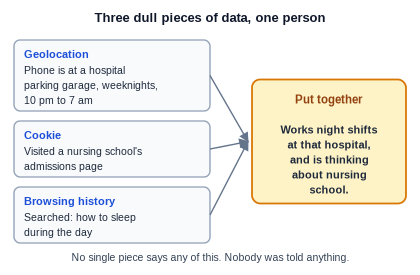
Aggregation of information including geo-location, cookies, and browsing history raises privacy and security concerns. Cookies can track browsing habits and be used for ads.
Targeted advertising is used to help individuals, but it can be misused at both individual and aggregate levels.
Personally Identifiable Information
Personally identifiable information, or PII, is information about an individual that identifies, links, relates, or describes them. Examples of PII include Social Security number, age, race, phone numbers, medical information, financial information and biometric data.PII can be used to stalk or steal the identity of a person or to aid in the planning of other criminal acts.
The list gives examples and is not complete: a full name, an email address or a photo of a face can identify a person too.
PII is not only a risk. PII and other information placed online can be used to enhance a user's online experiences. A map app that knows where you are can show the nearest bus stop. A music service that knows what you played can suggest what to play next. PII stored online can also be used to simplify making online purchases. A shop that keeps your payment details on file lets you check out without typing them again.
Safe Computing
Search engines can record and maintain a history of searches made by users, and can use search history to suggest websites or for targeted marketing.Websites can record and maintain a history of individuals who have viewed their pages. Devices, websites, and networks can collect information about where you have been, how you got there, and how long you were at a given location.
Information posted to social media services can be used by others. Combining information posted on social media and other sources can be used to deduce private information about you.
Users can control the permissions programs have for collecting user information, such as access to location, contacts, the camera and the microphone. Users should review the permission settings of programs to protect their privacy. A flashlight app has no reason to know where you are.
Commercial and governmental curation of information may be exploited if privacy and other protections are ignored. Companies collect and organize information about customers to sell things and to advertise; governments collect and organize records about residents for taxes, licenses and public services. Either collection can be leaked, sold or turned to uses nobody agreed to when the protections around it are skipped.